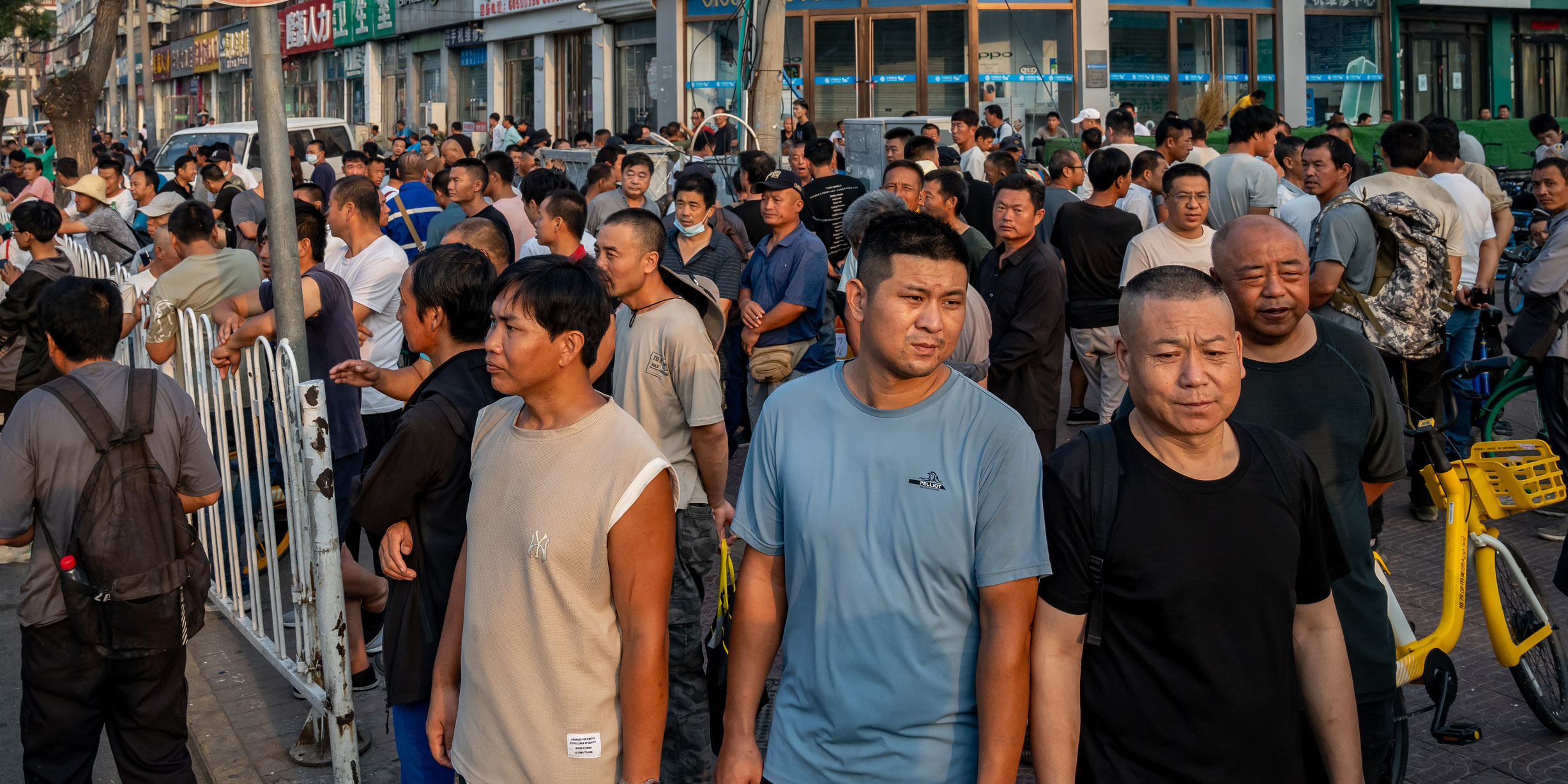
Love’s Labor’s Found: The Beijing Scholar Speaking Up for Hired Hands
Editor’s note: Over eight years, Cong Rui’an, a doctoral student in political science at Beijing’s Tsinghua University, regularly sought work as a day laborer in Majuqiao Town, one of the capital’s largest informal labor markets. In May, he published the book “Majuqiao Time: My Days as a Day Laborer,” offering his insights into the lives of these often-stigmatized workers. Here, Cong talks with The Paper about his experiences.
The Paper: What makes Majuqiao different from Shenzhen’s Sanhe job market, which attracted widespread attention a few years ago?
Cong: Majuqiao and Sanhe are often mentioned in the same breath, but they differ in many aspects. Sanhe was a relatively centralized day-labor market dominated by a handful of large staffing agencies, making it easier to regulate and shut down. Majuqiao, by contrast, is essentially an urban village: hiring takes place on the streets, and labor brokers operate in small, dispersed clusters, making the market more flexible and harder to eliminate. Sanhe has disappeared, but Majuqiao remains. The government has slated Majuqiao for transformation — from an old urban village for temporary workers to one designed for white-collar workers. And it’s worth noting that Beijing is the capital, so the political considerations are different, which naturally shapes the government’s approach to regulation.
Next is the people. At first glance, Sanhe seemed to draw a younger crowd. Majuqiao has plenty of young people, but fewer wait for work on the streets. The same goes for rough-sleepers, who were more common in Sanhe. Shenzhen (in Guangdong province) lies farther south, so the weather makes sleeping outdoors more feasible. Majuqiao is also an urban village rather than just a hiring market — long-term workers and local residents live alongside day laborers, so the street scene feels less like a “spectacle.”
Another issue that is often overlooked is long-term employment. A friend told me that although Sanhe was known for its day laborers, many people there were actually looking for steady jobs — they just didn’t attract the same curious stares. Sanhe lies in the Pearl River Delta, home to a great many small enterprises with high and flexible hiring needs. Beijing has far fewer businesses of this kind. As a result, workers chasing a freer life will naturally gravitate toward southern China rather than the capital. Many of those who come to Majuqiao are farmers looking for short-term work during the agricultural off-season, which helps explain why the workforce here skews older. In this sense, Majuqiao reflects the broader aging of rural China.
The Paper: What kinds of day labor have you done, and have you found anything that went against your expectations?
Cong: I’ve worked as a waiter, porter, parcel sorter, landscaper, factory worker, and in all kinds of temporary security jobs. If I get the chance, I’d like to work at an electronics factory or a construction site.
I try to keep an open mind, but what might surprise people is the laborers’ attitude toward work. Outsiders often fall into one of two extremes: some assume day laborers are drifting through life, unwilling to work seriously, while others romanticize them as tireless strivers fighting for survival. In reality, they are a bit of both. It’s true that some slack off — but that’s just part of the picture. Many take genuine pride in what they do, finding a source of self-respect in their speed, strength, and skill. In their circumstances, the ability to work is one of the few things they can call their own, and it’s a kind of social currency among their peers.
Another misconception is that only intellectual work is mentally exhausting. In fact, the psychological toll of manual work can be equally heavy, especially as many workers routinely face harsh and often degrading treatment from their supervisors. Physical fatigue can fade after a night’s sleep. Mental exhaustion is much harder to shake off. Over time, that constant emotional strain wears people down. They grow numb to hardship because, to make a living, they have little choice but to adapt. Yet beneath that numbness lies an uncomfortable question: how can we expect people who have long lived without dignity to suddenly live up to society’s expectations? Of course, people have to take responsibility for themselves, but the environments they live in matter. We act upon our surroundings, and they inevitably shape us. None of us becomes who we are in a vacuum.
The Paper: In what role did you interact with the workers? Did they or the employers and labor brokers ever sense you were different?
Cong: I’ve always approached them as fellow workers. Sometimes I’d say I was a student doing day-labor gigs. I’m quite introverted and rarely initiate conversations with strangers. But when I became just another worker, talking with people felt more natural. Whether we were waiting for work or had some downtime on the job, people were happy to chat. Putting those informal conversations alongside my formal research often led to the greatest insights.
As for whether anyone ever figured me out, no one ever brought it up. I’m sure some workers and brokers had their suspicions, but hardly anyone cared. We were all there to work. Who had the time or reason to pry?
The Paper: Are there any workers who have particularly stayed with you?
Cong: There are so many that it’s hard to know where to begin. Many struggle to make a living and work hard for their families. At the same time, there are moments when they feel lost, living one day to the next. These experiences are real, and they often coexist within the same person. I’d like to share a story that has little to do with work but reveals something essential about the people in Majuqiao.
One day, I witnessed a violent assault on the street. Arguments are common in Majuqiao, and fights break out. But it’s by no means a lawless place where people are indifferent. That day, two men had been drinking, a conflict flared, and one man struck the other with a brick. There was blood everywhere. The attacker stood a short distance away, expressionless and making no attempt to flee. By then, a crowd had gathered, and there was nowhere for him to go anyway. The police arrived a little later and took him away. As he sat in the back of the police car, surrounded by onlookers, he struck me as surprisingly young. But he was scruffy, with an overgrown beard and hair. He had probably been out of work for some time. Looking like that, he would have had little chance of finding work — recruiters rarely trust someone who looks so unkempt.
Then the ambulance arrived. They were short-handed, so I helped lift the injured man onto the stretcher. The moment I took hold of him, I was struck by how extraordinarily light he felt. He carried no bag, and the only thing that fell from his pocket was a phone charger. I slipped it back into his pocket and felt a wave of sadness. As we carried him, it occurred to me that he, too, must once have had dreams. He must have worked hard, struggled, and refused to give up easily. But life had slowly ground him down. In the end, a night spent drinking alone led to a fight, leaving him on a stretcher. And I couldn’t help thinking that the man who struck him had probably lived much the same kind of life.
After the injured man was taken away, all that remained on the ground was a brick and a pool of blood. A little while later, a dog wandered over and began sniffing at the blood. Instantly, the workers gathered nearby began shouting to drive the dog away. They probably didn’t even know the injured man, and they were not people you would describe as gentle, but at that moment they simply couldn’t bear to watch.
Was this some act of nobility? No. It was merely the most basic human instinct. Yet it was that instinctive compassion that made me realize we are all the same. It is only life that carries us to different places.
The Paper: What does Majuqiao mean to you now?
Cong: Maybe I should begin with some criticism I received recently. Some point out that in eight years I have visited Majuqiao just over 20 times, arguing that my research can hardly be taken seriously. Others say I’m just another Ph.D. student looking down on people at the bottom of society and using their lives for my benefit. I understand those criticisms, and I welcome them. But if those doubts become a reason to reject this kind of work altogether, then many important stories will never be told, and many realities will go unseen. Somewhere there’s a balance to be found — and it can only emerge through continued discussion.
I think much of the criticism comes from a particular idea of what fieldwork should look like — that the amount of time you spend somewhere is the only measure of how seriously you engaged with it. But Majuqiao was never a project for me. I didn’t have a research plan. No supervisor sent me there. I kept going because I wanted to understand the place and the people. Over time, it became part of my life — an anchor, really. Even when I wasn’t working there, I kept following what was happening: the workers’ group chats, recruitment posts, and anything I could find about Majuqiao online. It was a different kind of engagement — quieter, but no less continuous. As a result, my relationship with Majuqiao has stayed the same. Projects end, but life doesn’t. And that’s why I’ll keep paying attention long after this book.
Sometimes, going back to Majuqiao feels like going home. That isn’t because I love the place. In truth, Majuqiao isn’t somewhere you’d call comfortable or beautiful. It’s noisy, chaotic, and often weighs heavily on you. Yet I feel deeply attached. I know its smells and rhythms. I know what kind of people I’ll run into at certain intersections, and what kinds of work appear with the changing seasons.
At the end of the day, I don’t think it’s ever possible to fully understand another person’s experience. I’d rather acknowledge that limitation than pretend it isn’t there. All I can do is try not to distort people’s lives, not to turn them into commodities or spectacles. I want readers to encounter them as they are — as ordinary people, seen with the dignity and respect they deserve, rather than swallowed up by narratives that burden them with symbolism or moral judgment. But I also have to admit that complete justice is impossible. To imagine otherwise is arrogance.
I’ve never thought of the people in Majuqiao as “source material” or “tools.” Most of them I met only once, yet a single sentence or look has stayed with me. Majuqiao opened my eyes, and it has forced me to rethink things I’ve always taken for granted, to ask myself where I’ve come from and where I’m going.
But if you ask what I mean to Majuqiao, the answer is very little. The place doesn’t need me. Life there goes on, with all its warmth and hardships. But as this book has already had some social impact, I intend to put that to good use. The workers in Majuqiao have their concerns and demands, but too often they go unheard. If this book can carry their voices a little farther, then I hope to keep doing that — not only for them, but for working people everywhere.
Reported by Zhong Yuan.
A version of this article originally appeared in The Paper. It has been translated and edited for brevity and clarity, and is republished here with permission.
Translator: Chen Yue; editors: Wang Juyi and Hao Qibao.
(Header image: Day laborers gather at the Majuqiao labor market in Beijing, July 2023. Andrea Verdelli via VCG)